
Peptides vs Retinol: The Skincare Battle You Didn’t Know Was Happening
Both promise younger-looking skin. Both have the science to back it up. But they work in completely opposite ways, and choosing the wrong one could be holding your routine back.
8 min read·Anti-Aging·Ingredients Breakdown
Walk into any pharmacy or scroll through any skincare brand’s website and you’ll find two ingredients competing for prime real estate on the anti-aging shelf: peptides and retinol. Both are backed by decades of research. Both are in products that cost anywhere from $15 to $500. And both, their devotees insist, will turn back the clock on your skin.
But here’s what most skincare content won’t tell you: these two ingredients are not doing the same thing. At all. Understanding how they actually work, at a cellular level, changes everything about how you should be using them.
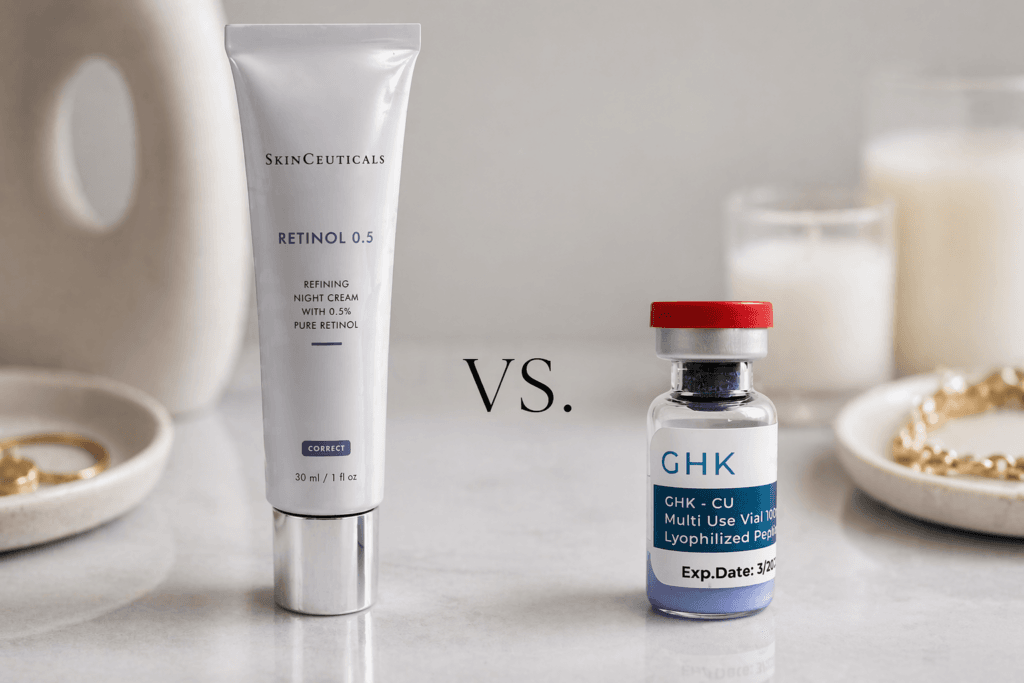
First, a quick biology lesson
Your skin’s youthful appearance comes down largely to one protein: collagen. It’s the structural scaffolding that keeps skin firm, bouncy, and smooth. From your mid-20s onward, your body produces less of it, roughly 1% less per year. By 40, you’ve lost a significant portion of what you had in your 20s.
Both peptides and retinol target this collagen problem. But they arrive at the solution from completely different directions.
“Retinol speeds up your skin’s biological processes. Peptides communicate with your skin to start them in the first place.”
How retinol works
Retinol is a form of vitamin A, and it works by being converted inside your skin cells into retinoic acid, the active compound that actually does the work. Retinoic acid binds to receptors in your skin cells and essentially reprograms their behaviour.
It accelerates cell turnover, pushing old, dull cells to the surface faster and bringing fresh cells up from the deeper layers. It also directly stimulates fibroblast activity, fibroblasts are the cells responsible for producing collagen. The result, over months of consistent use, is measurably more collagen, fewer fine lines, and significantly more even skin tone.
What retinol actually does inside your skin
- Converts to retinoic acid, which binds directly to cell receptors
- Speeds up skin cell turnover (epidermal renewal)
- Directly stimulates fibroblasts to produce more collagen
- Inhibits enzymes that break down existing collagen (MMPs)
- Regulates melanin production, reducing hyperpigmentation
The downside of retinol’s aggressive approach is that it’s genuinely disruptive to the skin barrier — especially early on. Redness, peeling, dryness, and increased sun sensitivity are common during the first weeks of use. This isn’t a sign it’s not working; it’s a sign your skin is adjusting to a significantly accelerated biological process.
How peptides work
Peptides are short chains of amino acids — essentially fragments of proteins, including collagen itself. When applied to skin, they don’t force any biological process to happen. Instead, they act as signals.
Here’s the elegant part: your body naturally uses peptide fragments as a communication system. When collagen breaks down, it releases specific peptide sequences that signal to fibroblasts: “collagen has been damaged here, produce more.” Topical peptides mimic this signal, tricking the skin into thinking collagen has been lost and needs to be replaced.
What peptides actually do inside your skin
- Mimic natural collagen breakdown signals to trigger production
- Bind to surface receptors without entering the nucleus
- Some (carrier peptides) deliver copper ions that activate wound healing
- Neurotransmitter-inhibiting peptides (like Argireline) relax muscle contractions
- Enzyme-inhibiting peptides protect existing collagen from degradation
Different peptides do different things depending on their sequence. Signal peptides like Matrixyl (palmitoyl pentapeptide-4) stimulate collagen synthesis. Carrier peptides like GHK-Cu (copper peptide) facilitate wound healing and remodelling. Neurotransmitter-inhibiting peptides like Argireline , often called “Botox in a bottle”, temporarily reduce muscle contractions that cause expression lines.
The experience of using peptides is also radically different from retinol. No purge. No peeling. No sun sensitivity. Peptides work gently, gradually, and with almost no irritation risk.
Head to head: the key differences
Peptides
- Works via biological signalling
- No irritation or purge period
- Safe for sensitive skin
- No sun sensitivity
- Results appear slowly over months
- Safe during pregnancy (most types)
- Targets multiple skin concerns
Retinol
- Works by reprogramming cell behaviour
- Purge/adjustment period of 4–8 weeks
- Not for sensitive or reactive skin
- Increases UV sensitivity — SPF mandatory
- Measurable results within 3–6 months
- Avoid during pregnancy
- Best for collagen loss and pigmentation
Who should use what?
Sensitive skin
Peptides
Oily / resilient
Retinol
Pregnant / nursing
Peptides
Beginner (20s–30s)
Peptides
Deep wrinkles
Retinol
Both concerns
Stack both
Use peptides if you’re new to anti-aging ingredients, have sensitive or reactive skin, are pregnant or breastfeeding, or want a maintenance routine without the drama. They’re also excellent for younger skin (mid-20s to early 30s) as a preventative measure before significant collagen loss begins.
Use retinol if you want the most clinically validated anti-aging ingredient available over the counter, have established wrinkles or significant pigmentation issues, and have skin that can tolerate an adjustment period. Retinol remains the gold standard of topical anti-aging — nothing else has quite its body of evidence.
Can you use both?
Yes, and for many people, the answer is to use both. They’re not competing; they’re complementary. Peptides work on the signalling side; retinol works on the cellular machinery side. Together, they hit collagen loss from multiple angles.
☀
Morning: Peptide serum under SPF 30+ moisturiser. Peptides have no sun sensitivity issues and pair well with antioxidants like vitamin C.
◑
Evening: Retinol (start low — 0.025% to 0.05%) followed by a nourishing moisturiser to buffer irritation. Add a peptide moisturiser on top if skin tolerates it.
One thing to avoid
Don’t layer peptides directly on top of retinol in the same step. Retinol temporarily lowers skin pH, which can interfere with how certain peptides bind to receptors. Apply retinol, wait for it to absorb, then add your peptide product , or keep them in separate AM/PM routines entirely.
The bottom line
This isn’t a battle with a winner. Retinol is not better than peptides. Peptides are not a “gentler substitute” for people who can’t handle retinol. They’re two different solutions to the same biological problem, and understanding which one you need, or how to combine them, is what separates an effective routine from an expensive one.
If you’ve been avoiding retinol because of the side effects, peptides are not a compromise, they’re a genuinely powerful option. And if you’ve been loyal to retinol for years, adding peptides might be the upgrade your routine has been missing.
Either way, you’re not guessing anymore. You know exactly what’s happening inside your skin, and that changes everything.